
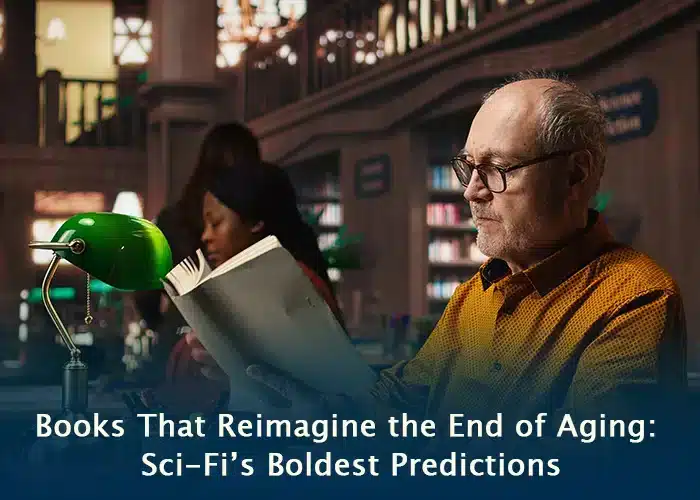
You probably want to live forever. Most of us do. You imagine endless time to learn, travel, and love. But have you thought about the cost? What happens to your mind after two hundred years? What happens to the world if no one ever leaves it?
Writers have asked these questions for decades. They use sci-fi longevity novels to run the simulation for us. They show us futures that are bright, dark, and terrifyingly weird. These stories aren’t just about technology. They are about what remains of us when the clock stops ticking.
Here is a look at how the boldest books reimagine the end of aging.
What if the cure breaks the world?
Imagine a simple injection. You take it, and your aging stops. You don’t become Superman. You just stay thirty forever. This is the premise of The Postmortal by Drew Magary.
It sounds like a dream. But in the book, it quickly becomes a nightmare.
You see the government ban the cure. Then you see the black market take over. Finally, it becomes legal, and the real problems start. People stop retiring. Jobs vanish. The planet runs out of food. You watch as marriage contracts have to be rewritten because “forever” is too long.
Most sci-fi longevity novels focus on advanced tech. The Postmortal focuses on us. It asks how a normal society handles an abnormal change. You might think you want eternal youth. But would you want it if it meant the collapse of civilization? This book suggests that death is the only thing keeping the gears of society turning.
Can money buy you eternity?
You know the saying. You can’t take it with you. But what if you never have to go?
Richard Morgan’s Altered Carbon presents a chilling answer. In this future, your consciousness is stored in a “cortical stack.” It is a small disk in your neck. If your body dies, you just buy a new one. They call these bodies “sleeves.”
This changes everything. Death is no longer the great equalizer. It is an annoyance for the poor and a choice for the rich.
The wealthy elite, called “Meths,” live for centuries. They grow bored. They grow cruel. They lose their humanity because they have no fear of consequences. You see them treating bodies like disposable clothes. This is a common theme in sci-fi longevity novels. They warn us that mortality is the anchor for our morality. Without the fear of death, you might lose the ability to care about life.
What happens to your memories?
Your brain was not built to last a thousand years. It fills up. It gets tired.
Kim Stanley Robinson explores this in his Mars Trilogy. The characters use a longevity treatment to live for centuries. They build a new world on Mars. They terraform a planet. But their minds struggle to keep up.
You see characters forgetting entire decades of their lives. They meet old friends and don’t recognize them. They suffer from a “quick decline” where the system just shuts down. It is a realistic look at biology.
These sci-fi longevity novels ask a deep psychological question. Are you still “you” if you can’t remember who you were a century ago? Perhaps we need a fresh start more than we need endless time. Robinson suggests that living forever might be the ultimate form of amnesia.
Is death just a backup error?
Cory Doctorow takes a different approach in Down and Out in the Magic Kingdom. In this future, death is cured. It is obsolete.
You backup your brain like a hard drive. If you die, you are restored into a clone. You lose maybe a few hours of memory. That is it.
Life becomes a game. People live in Disney World. They don’t work for money. They work for “Whuffie,” which is a reputation score. If you get bored, you can “deadhead.” This means you turn yourself off for a few years to skip the dull parts of history.
This is one of the few sci-fi longevity novels that feels like a party. But there is a hollow feeling underneath. If nothing has a permanent end, does anything have meaning? You see characters struggle to find purpose when the stakes are zero. They create drama just to feel something. It makes you wonder if risk is an essential vitamin for the human soul.
Would you trade your body for war?
Sometimes the price of youth is service. In Old Man’s War by John Scalzi, you don’t get the cure for free. You have to sign up.
On your 75th birthday, you can join the Colonial Defense Forces. You leave Earth forever. In exchange, they transfer your consciousness into a new body. It is green. It is strong. It is genetically enhanced to kill.
You get to be young again. But you have to fight aliens in a brutal universe.
This book adds a unique twist to the list of sci-fi longevity novels. It treats youth as a commodity. It is a piece of military equipment. The main character, John Perry, has to decide what he is willing to do to stay alive. He discovers that his new body has its own instincts.
You have to ask yourself a hard question. Would you kill to be young again? This story suggests that the drive for life is the most dangerous weapon of all.
Why do we love these stories?
We read sci-fi longevity novels because we are afraid. We fear the end. We fear being forgotten.
These books act as a safe space to explore that fear. They let you try on immortality for size. You can see the flaws in the logic. You can see the social unrest. You can see the boredom.
Maybe you realize that the current system isn’t so bad.
The best sci-fi longevity novels don’t just predict the future. They reflect the present. They show us that we are defined by our limits. The time you have is precious because it runs out. If you had forever, you might never start that project. You might never say “I love you” because you could always do it tomorrow.
What is the final verdict?
Science is moving fast. We are treating aging like a disease. We might not get stacks or green bodies soon, but we will live longer.
You need to be ready for that. You need to think about how you will fill the time. Will you be like the Meths in Altered Carbon, hoarding wealth and power? Or will you be like the pioneers in the Mars Trilogy, trying to build something new despite the fatigue?
Reading sci-fi longevity novels is the best preparation. They teach you that living longer doesn’t automatically mean living better. You have to do the work to make the extra years count.
Summary
The dream of eternal life is a trap and a gift. It depends on how you use it. The characters in these books show us the way. They make mistakes so you don’t have to.
Whether it is the chaotic streets of The Postmortal or the reputation games of the Magic Kingdom, the lesson is clear. Identity matters more than biology. You are not just a body. You are a collection of choices.
So, go ahead and wish for more time. But read these sci-fi longevity novels first. They might change what you wish for. You might find that a good ending is just as important as a long story.
Looking for your next great read? Get Stanley Paden’s book today!